

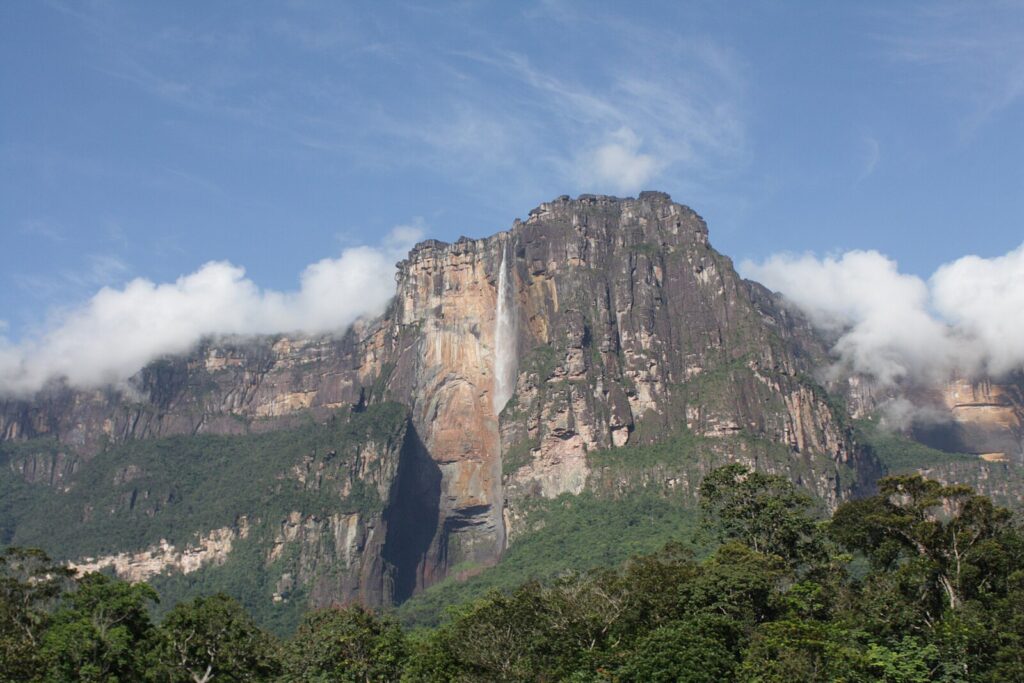
The wall of the Auyán-tepui is one of the most recognisable exit points in BASE jumping. Angel Falls comes off it with a 979-metre drop — the highest waterfall in the world — and jumpers have been throwing themselves off the same rock since the 1980s.
Start with the part that matters most: this is not a bookable activity. There is no operator you can pay to take you. What follows is what the jump actually involves and why it has the reputation it has.
The exit
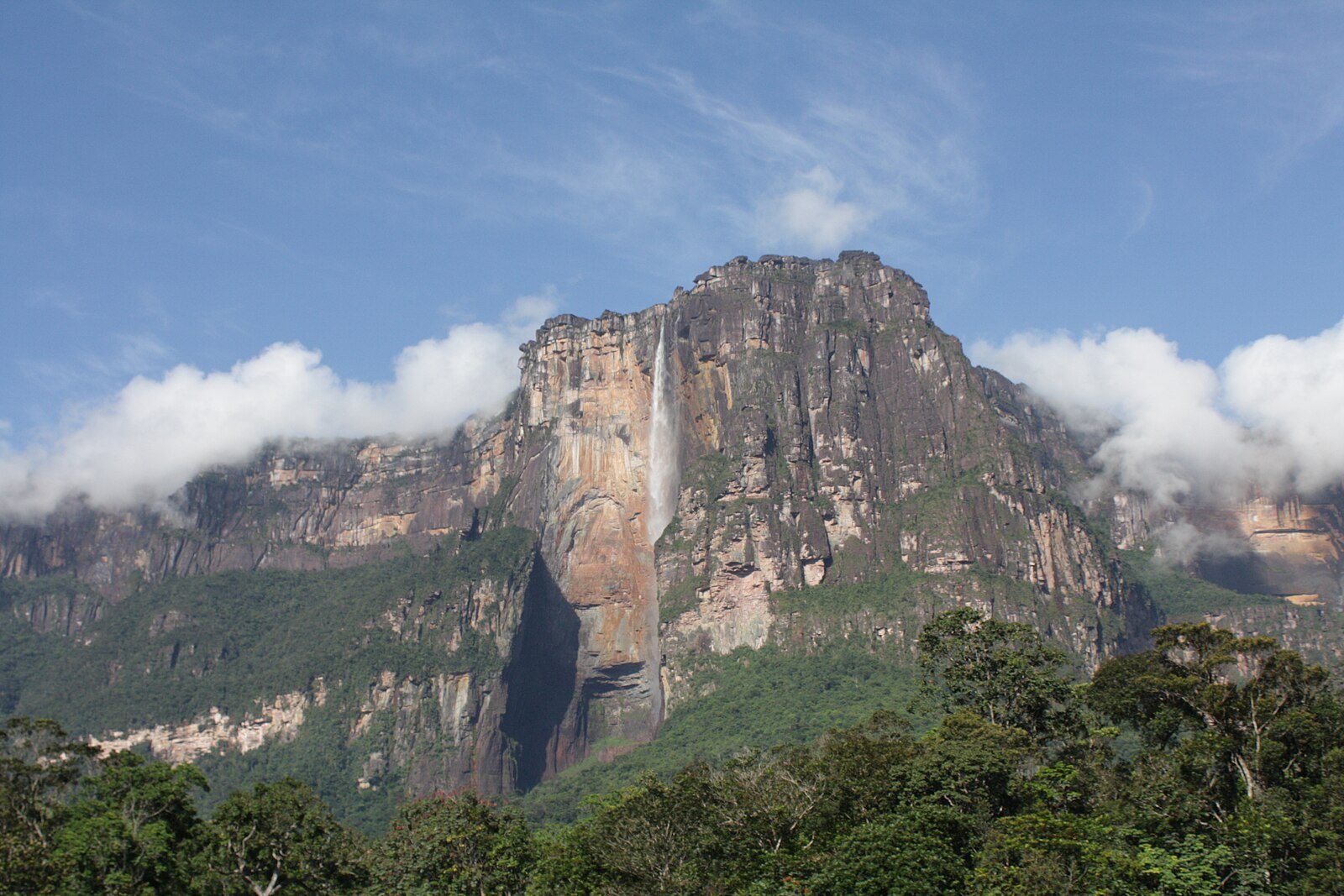
The tepui is a sandstone table with vertical sides, which is exactly the geometry BASE jumping wants: a clean drop with something to fly away from. Nearly a kilometre of it gives an unusually long window — time to track or fly a wingsuit out from the wall before the canopy has to come out.
What it does not give is a clean face. The wall is stepped and broken in places, the falls throw mist across it for much of the year, and the landing options below are riverbank and forest rather than an open field. Jumpers aim for the sandy banks at the base, where boats wait to take them out.
A short history
The first jump from Angel Falls is generally credited to the Venezuelan Max Botto in November 1983. Others followed through the 1990s, mostly as private expeditions with whatever permission they could arrange.
The turning point usually cited is January 2008, when a group of thirteen jumpers organised by Apex BASE with Venezuelan support reportedly secured the first civilian permit issued by the national parks authority specifically for BASE jumping the falls. That matters more than it sounds: it moved the activity from tolerated to formally authorised, at least for that expedition.
Later jumps have kept the site in the sport’s public eye, among them a trio of professional women jumpers who described the same three problems everyone describes — proximity to the wall, blinding mist, and an unforgiving landing area.
Getting to the top is the hard part
The jump takes under a minute. Everything around it takes days.
- Reaching Canaima. There is no road into this part of the park. You fly in, as described in Canaima National Park.
- Reaching the summit. The top of the Auyán-tepui is either a multi-day trek through forest and up the flank, or a helicopter lift where one can be arranged. Neither is casual, and both depend on weather.
- Extraction. After landing you are at the bottom of a wall in dense forest beside a river, and you leave by boat. The recovery is part of the expedition, not an afterthought.
- Permission. This is a national park and a UNESCO World Heritage site. Jumping without authorisation is a problem with the park authority, not a technicality.
The risk profile, plainly
BASE jumping carries a fatality rate that no amount of experience removes. This site adds its own layers on top of that baseline:
- Mist. The falls pulverise into cloud before reaching the ground. Jumping into that means losing visual reference at exactly the wrong moment.
- The wall. Not uniformly vertical. Tracking or flying away from it is the whole task.
- The landing. Forest, river and rock. There is no bail-out field.
- No rescue. This is the one people underestimate. An injury at the base of the Auyán-tepui is hours from a boat and a day or more from a hospital. There is no helicopter on standby.
Which is why the people who do this arrive as an organised expedition with their own medical planning, and why the number of jumps here stays small.
For the rest of us
The same wall is the reason ordinary visitors come. You see it from a light aircraft on the overflight, or from the viewpoint reached by boat up the Carrao and Churún rivers — the trip that most people mean when they say they have been to Angel Falls. The detail, including which season actually has water in it, is in the Angel Falls guide, and the tepui landscape it belongs to is in the Guiana Shield.
Whichever version of the trip you are considering, check whether the country is currently reachable first.