

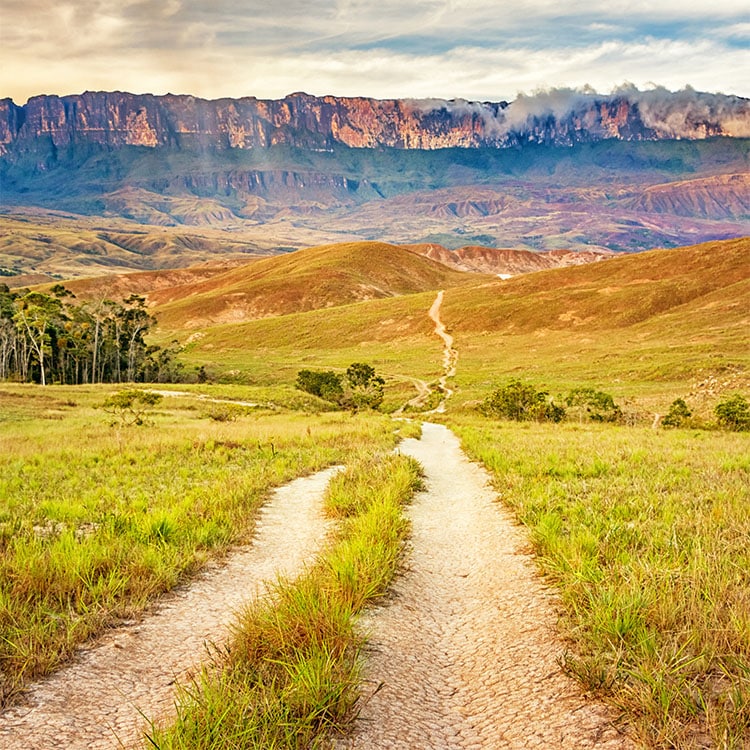
Venezuela has two seasons, not four: a dry season from December to April and a wet season from May to November. That is the whole calendar, and it is almost useless on its own — because the best month depends entirely on which Venezuela you are going to, and for the country’s most famous sight the answer is the opposite of what you would guess.
Angel Falls: go in the wet season
This is the one that trips people up. Angel Falls needs rain to be a waterfall.
In the dry season the flow drops, sometimes to a thread, and the rivers get too low for the boat journey upstream from the Canaima lagoon. What you are left with is the overflight — worth doing, but you never stand in front of it.
In the wet season the falls run full and the boats operate. The trade is cloud: the wall spends a lot of the day inside it, and the falls appear and disappear. Roughly June to December is when the river trip runs, with the strongest flow from August to November.
If seeing the water fall 979 metres is the reason for the trip, plan around this and let the rest of the itinerary follow.
Roraima and La Gran Sabana: go in the dry season
The opposite logic. Roraima is a six to ten day walk, and the approach crosses rivers. In the wet season those crossings are harder, the ground is a swamp and the camps are miserable. December to April is the season for the trek.
It will still rain on top — the plateau makes its own weather all year — but the walk in and out is a different proposition.
Same for La Gran Sabana, which is a driving destination: the dry season is when the road and the tracks down to the waterfalls are reliable.
The Andes: December to March
For Mérida and the high mountains, the dry season is clear mornings and visible summits. In the wet season the cloud sits on the range and the cable car can run all day into a white wall — you pay to go up 4,765 metres and see nothing.
Go early in the day whatever the season: the cloud builds from late morning almost year-round.
The Caribbean: any time, with a preference
The coast and the islands work all year — warm water, warm air, small seasonal variation. The dry season gives clearer water and more reliable sun, which matters if you are snorkelling or diving.
For wind sports, the reverse is true of most places: the trade winds are strongest from December to April, which is peak season for kitesurfing and windsurfing.
The other calendar: Venezuelan holidays
Weather is not the only thing that changes by month. Domestic tourism concentrates hard into four windows, and in those weeks it is availability and price that decide your trip, not rainfall:
- Christmas and New Year. The biggest one. Book months ahead or do not travel then.
- Carnival, February or March depending on the year.
- Holy Week. The coast fills completely.
- August. School holidays.
Outside those, the small camps and guesthouses that most Venezuelan destinations run on have space, and you get the place to yourself.
Month by month, in one table
| Months | Angel Falls | Roraima and La Gran Sabana | The Andes | The Caribbean |
|---|---|---|---|---|
| Dec – Feb | Flow dropping; boat trip ending | Best | Best | Best; windiest |
| Mar – Apr | Lowest flow; overflight only | Good | Good | Good |
| May – Jul | Filling; boats start | Wet, hard going | Cloud building | Fine |
| Aug – Nov | Best flow | Wettest | Cloudiest | Fine |
If you only get one window
People ask for the best time to go to Venezuela as though the country had one answer. It does not — but if you have to pick a single window with no other constraint, there is one that works.
Take late November or early December, before the Christmas rush. The falls are still running and the boats are still going, the Andes are clearing, and the Gran Sabana road is drying out. It is the only part of the year where the three big regions overlap in reasonable condition.
The second-best answer is April: excellent for the mountains and the tepuis, weak for Angel Falls.
Access to Venezuela, August 2026. Earthquakes on 24 June 2026 put the country under a nationwide state of emergency and closed Simón Bolívar International (Maiquetía), the main airport for Caracas, which has not handled scheduled passenger flights since. Some airlines have been operating into Valencia instead. Cargo restarted in early August and passenger services are reported to be resuming through temporary facilities from late August, with full rehabilitation projected for December 2026. Confirm with your airline before booking anything.
Whatever you pick, the seasons are the easy variable in Venezuela. The rest of the planning — insurance, cash, transport, whether to go at all — is in is Venezuela safe to travel and travel in Venezuela.