

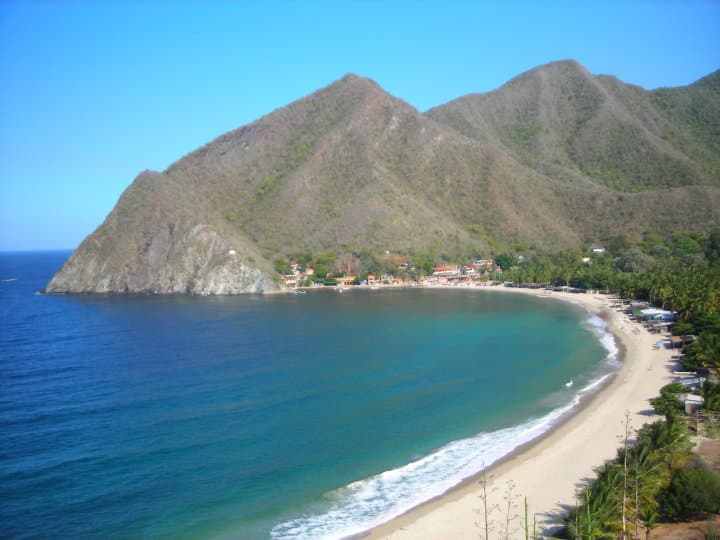
Henri Pittier is the oldest national park in Venezuela. It was created in 1937 under the name Rancho Grande and covers around 1,070 km² of Aragua state, in the Cordillera de la Costa. What makes it distinctive is how fast it drops: in a few kilometres it goes from montane cloud forest to Caribbean beaches.
Two parks in one
Henri Pittier makes more sense if you separate its two halves:
- The mountain. Steep cloud forest, with nine main rivers and more than 500 recorded bird species. This is the part that draws scientists and birdwatchers.
- The coast. Bays and beaches on the far side of the range, among them those of Choroní, reached by crossing the park on a mountain road.
Why this park exists
It carries the name of Henri Pittier, the Swiss geographer, botanist and ethnologist who arrived in Venezuela in 1917 and catalogued more than 30,000 of the country’s plants. He was the one who pushed for its creation, at a point when the cloud forest here was under threat from fires and the spread of farmland.
It was declared in 1937 by decree of president Eleazar López Contreras, with 90,000 hectares. In 1953 it was renamed Henri Pittier, and in 1974 a further 17,800 hectares were added, taking it to the 107,800 it has today.
What there is to see
The plant life includes samán, cedar, ceiba and mahogany, along with orchids, ferns and bromeliads. But what the park is known for is birds: the more than 500 recorded species make it one of the most important observation points in the country.
The Portachuelo Pass, the saddle that crosses the range inside the park, works as a migration corridor: birds and insects funnel through it on their seasonal movements, and that is what led to a biological station being built there.
The Rancho Grande Biological Station
Inside the park there is a biological station dedicated to cloud forest research. In 1989 the Scientific Society of Friends of Henri Pittier National Park was founded alongside it, to sustain the study of its plants and wildlife and to protect the habitat.
The park’s beaches
The coastal side of Henri Pittier holds the beaches that people from Caracas and Maracay have closest to hand. Choroní and its port, Puerto Colombia, are the reference; from there the peñero boats leave for the beaches with no road access.
Getting there
The natural way in is Maracay, the capital of Aragua, south of the park. The road that crosses the range to the coast starts there. It is a narrow mountain road with continuous bends: the journey takes a long time even though the distance is short. There is public transport from Maracay to the park’s coastal villages.
A protected park
Management is INPARQUES’s responsibility. As the oldest park in the country and the one that protects the cloud forest of the Cordillera de la Costa, use restrictions — access to certain zones, permitted activities — are part of how the area works.
In the same range
Henri Pittier shares its mountain system with El Ávila, the mountain of Caracas, and with Colonia Tovar, further east. The full survey is in the national parks of Venezuela and in the Venezuela guide.